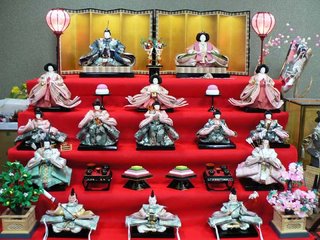
March 3rd was traditionally Girl’s Day, a national holiday when families pray for the health and happiness of their daughters. Nowadays it is no longer a holiday but the Hina Doll Festival is still celebrated. Families display sets of dolls that have often been handed down through generations, and make offerings of fresh mochi (rice cakes) coloured green, white and pink and cut into diamond shapes. The red/pink is for chasing evil spirits away, the white is for purity, and the green is for health. The sets of dolls are displayed on a five or seven tiered stand covered in red carpet, like a small set of stairs leading up to where the Emporer and Empress perch on the top step. The next step contains three court ladies, followed by five musicians, two ministers, and three servants ending the bottom row in a five-tiered display. Some of the older dolls I saw were over 100 years old.
 Hina Matsuri, like many things Japanese, was a cleansing custom originally imported from China: a girl’s imperfections are passed into a paper doll which was subsequently floated down the river. In some regions the custom is still practiced. My friend Omae San invited me to view the Hina Doll Festival in the neighbouring town of Utazu. The weekend after the 3rd, families and businesses within the old part of the town had opened up their homes for the general public to view their displays. To be honest, I was much more interested in seeing the inside of Japanese homes than in viewing the doll sets; many newer versions I had seen for sale in stores, and considered a tad gaudy for my taste. We went to the Utazu Town Office to drink some ceremonial sake and collect a map of the walking route. Some 80 or 90 residences were partaking in the festival. It was a beautiful late winter’s Sunday, crisp and blue, pleasant in the sun, a tad nippy in the shade. Our first stop was a very large, old house that has been restored as a museum of some sort. Guides were on hand to explain the history of the dolls and the house, and between their exuberance, Omae San’s patchy English and my delinquent Japanese I think I became more confused than enlightened. I spent a lot of time nodding my head enthusiastically and spouting Ahh sooo desu ne, guessing at meanings that an occasional ray of understanding would splinter into beautiful rainbow textured shards.
 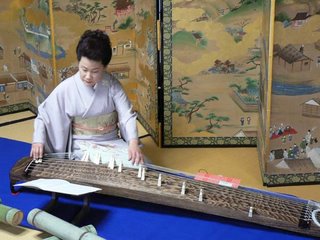 In the first main room, a women dressed in a kimono, knelt in front of a Koto, a thirteen stringed zither like instrument, which she was delicately playing. It lent a perfect atmosphere to this perfectly preserved old house built around a central garden, the rocks, moss and stone pools the zen image of how a Japanese garden should look. The corridors that edged the house double as an insulation barrier; large windows letting in light, the rooms themselves separated by sliding paper screens that can be opened or removed to allow ventilation and more or less light as desired.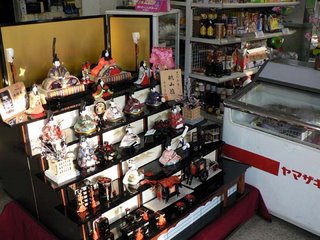
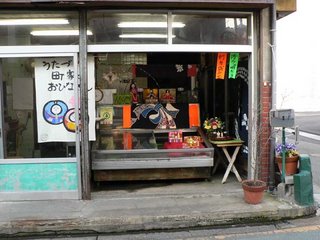 We finally head back outside and followed the meandering groups of people drifting here and there. Some houses had a small display viewable through a window, others had devoted whole rooms to the hospitality of their collections. A few stores had joined in the celebrations; I particularly enjoyed the contrast created by this small grocery store that had forsaken product space for doll space, and a fish shop that had managed to squeeze in a display.One of the last houses we visited was home to a women who had spent some time studying in Australia, some years back. On display they had a picture painted by an old man of the district, which she insisted on giving to me. It being Sunday afternoon, the Matsuri was drawing to a close and she had been looking for a suitable home for this piece. In a gesture of international solidarity, I a chance stranger she had just met, was to be the recipient of this gift. She also made the gift through Omae San, so I wasn’t really sure if she was giving it to me or not until we walked outside and Omae San presented it to me. Another instance of the generosity of spirit of the Japanese people that has made me feel so welcome since I have been here.
Thank you.
As I walk back to my apartment after work, a little old lady is walking in front of me, hunched over from too many years in the rice paddies perhaps. She carries an extra long pair of BBQ tongs and a paper bag. As I walk behind watching, she stops and hunches even further over to pick up a stray cigarette butt someone has discarded into the gutter and deposits it into her paper bag.
An early morning, a later than expected start, a long day. But omoshiroii.It was my first time across the Seto Ohashi Bridge, that which I have gazed at, run towards and made partway across upon a wayward train. Actually I think it was my Kanji reading ability that was wayward. This mammoth engineering feat, part of a massive road expansion scheme last century, comprises 12km of adjoining bridges which cross from Shikoku to Honshu. As I may have previously mentioned, Shikoku was the backwater until 1988, when many of those reading this would have been caught up in a hype of an altogether different kind. Most in Japan still regard those from my home island as country bumpkins, and after the coolness Hiroshimians displayed today, I would be inclined to agree. But who wants to live in a big city anyway?However, as big cities go, it struck me (in a very fast day) as a pretty liveable place. It’s surrounded by mountains, and the longest tunnels I’ve yet encountered in Japan, some over 2km. However, being guided around by your Japanese friend in a very comfortable car with nabe, jostling from carpark to carpark, possibly isn’t the best way to get a good impression of a place. The pleb in me would much rather have been getting lost on the tram system. Despite nabe, we still managed to get lost though. Nabe is a navigation system that tells you where you are and how to get where you want. All the important places of interest are included, from the Peace Park to the major department stores. Pretty much all new cars have one and Japanese aren’t big on old cars. A calm woman’s voice interrupts your conversations to politely tell you where and when to turn, when you’ve arrived somewhere, etc. It also doubles as a TV in case the batteries on your keitai (cell phone) are flat and you need an electronic device to distract you whilst you’re driving. I guess a tv would keep the kids quiet forever when you subsequently run into a concrete tunnel wall. So speaking of death and destruction, our first stop in Hiroshima was the Memorial Peace Park. If I sound a tad cynical it’s probably because my emotional defences are pretty high after seeing too many photographs and relics of scorched and mangled bodies. My friends scored themselves a volunteer guide and though I was quite happy picking up about 20% percent of what she was saying (my Japanese is slowly getting better) and reading the helpful English explanations lining the walls, they decided this was too important an occasion and the gist would not suffice, so I got my own personal guide and we were subsequently parted.Hiroshima has historically been a military centre of power. The Sino-Japanese war and the following Manchurian invasion were launched from here. When the Pacific War broke out in 1941, Hiroshima served again as an important military base. And when the Americans were looking for a place to drop a devastating weapon, Hiroshima served a number of important criteria. It was more than three and a half kilometres wide and surrounded by mountains, this making it an excellent guinea pig city on which to test their new toy. Most importantly, intelligence indicated that Hiroshima was the only military stronghold that contained no POW camps. I guess dropping the world’s first atomic bomb on your own people is bad for PR.Keiko San, my guide, spent a lot of time telling me how nasty the Japanese soldiers had historically been in conflict. It made me feel uncomfortable hearing this peaceable women denigrate her fellow countrymen so. She went on and on about the atrocities the Japanese had committed and I wondered if she hadn’t been to some modern day Clockwork correction camp. The Koreans who are outraged by Koyazumi’s visits to the war shrine to pay respect, because a small number of known war criminals are included in the list of soldiers, should listen to this women if they want proof of how contrite the Japanese are. But that’s a different debate that I don’t understand completely.The Japanese, like most people, are fiercely proud of their culture and identity. I asked Keiko San how it felt, day after day, telling the world (for their were tourists from all over) what bad people the Japanese were. For her, the essence was in the tense; the Japanese were, but now are not.After the Japanese surrendered, a couple of days after Nagasaki was likewise flattened, a contingent of peacekeeping soldiers was sent into Japan to restore order. Keiko San described how the Hiroshimians were scared of the soldiers that were to be sent over because they expected them to loot, pillage and rape, as is the wont of soldiers. Instead, she said, the people were surprised by a bunch of friendly Australians, and here she went into raptures over how wonderful the Aussies were. I felt ill and embarrassed.It was weird. The Japanese, though they had changed, would forever have to bear the shame of past atrocities; whilst the Australians, for once being of good behaviour, would always be heroes to these people. I tried to explain about recent conflict in the Middle East, how Australians are as base as anyone, but that didn’t matter. My brain was unsuccessfully searching for a sixth gear as I tried to mesh these juxtaposing attitudes. For the first time in Japan I felt truly culturally alienated from the Japanese. Most things I don’t understand in Japan I put down – perhaps ignorantly – to ignorance. But this wasn’t a question of lack of information or communicational ability. We just thought differently. Not as I might have a different opinion to someone with a similar educational and cultural background, but on a different planet. And I spent the rest of the week trying to get my head around this.Keiko San was a peace activist and an anti-nuclear activist. Her grandmother had been one the of survivors of the bomb, but like many, was too traumatised to talk about it. Keiko San, like many of the next generation, had taken it upon herself to educate about the dangers of nuclear capabilities. I told her about Jabiluka, of which she hadn’t heard, and instead of convincing her of the evilness of the Australian Government, it confirmed me as a fellow activist and she found that sixth gear I was still looking for. Unfortunately I wasn’t in the mood to be preached at and soon got tired of her well intentioned but slightly jarring hypes for peace. I believe there’s more chance of the Bush family giving over their entire fortune to provide AIDS relief in Africa than there is of us ever finding world peace through love and enlightenment.Having said that, don’t get me wrong, I think what Keiko and her colleagues are doing is bloody excellent. These people give up vast tracts of their time to educate the rest of the world about the effects of the Atomic Bomb on Hiroshima. Just because I don’t agree with all her views, doesn’t mean I consider them less relevant. It takes a whole planet of people to change our world and there can never be one true formula.We continued to pass by remains of clothing, photos of burnt and charred bodies, and a museum full of emotionally plaguing material. However, I didn’t need to see this stuff and was more interested in learning about the radiation effects After spending several years hearing how the half life of radiation dug up from Jabiluka would last 20,000 years - more of less by a few thousand years - I have always been curious how it possible for a city to be rebuilt on a site where a bomb was exploded, whilst the area around Chernobyl will never be habitable whilst our species is still writing history. Unfortunately Keiko was unable to give me an answer so had to turn to the internet:The initial radiation from the explosion lasted for a minute and the strongest effects were felt within a radius of one km from the hypocentre. The residual radiation lasted for 100 hours; anyone who came within this zone during this period also suffered from radiation exposure. However, irradiation of soil and buildings is caused from the absorption of radioactive neutrons. “Neutrons comprise 10% or less of A-bomb radiation . . . in contrast, gamma rays--which comprise the majority of A-bomb radiation--do not cause ground materials to become radioactive.” *Thus most of the radioactivity decayed quickly and the levels of residual radiation in Hiroshima are less than normal background levels.The last part of the tour was dedicated to a little girl called Sadako. She was a baby when the bomb struck, though suffered no noticeable effects. At age 12 she suddenly developed leukaemia, then known as A-Bomb disease. As you would be, she was super scared as all those who had contracted the disease had died. Her friend told her of a legend whereby if a sick person folds 1000 paper cranes, they will get better. She died having folded only 644 cranes.Her friends started folding cranes to honour her memory and word soon spread. Money streamed in from all over the world and 3 years later a monument was built in Sadako’s memorial. Every year children from all around the world send cranes to be placed at the memorial annually on August 6th, Hiroshima Day.
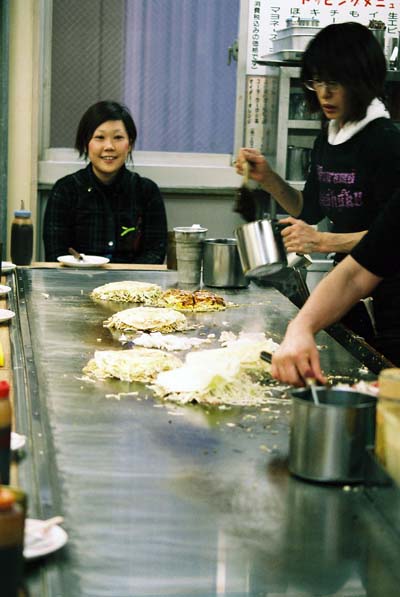
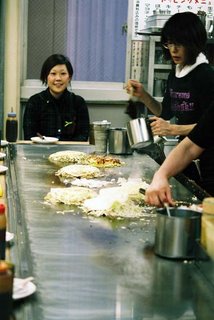 We had ostensibly come to Hiroshima to do some shopping for Yuka Chan’s work, (this is her grinning expectantly on the left) things she couldn’t get on Shikoku. When I asked why we hadn’t gone to Okayama or Osaka, two big cities much closer, she made various asides about traffic and the difficulty of driving, and then grinned and said “Okonomiyaki.” Each region has it’s own speciality dish that cannot be made authentically outside of that region. To eat Sanuki Udon outside of Sanuki, the old name for the region I live in, is considered a heresy. People come from all over Japan to eat Udon noodles in Kagawa, and similarly, we had come to Hiroshima to eat Okonomiyaki.Rather like a
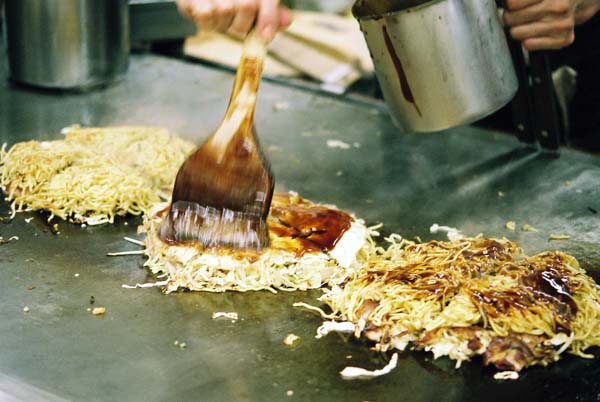
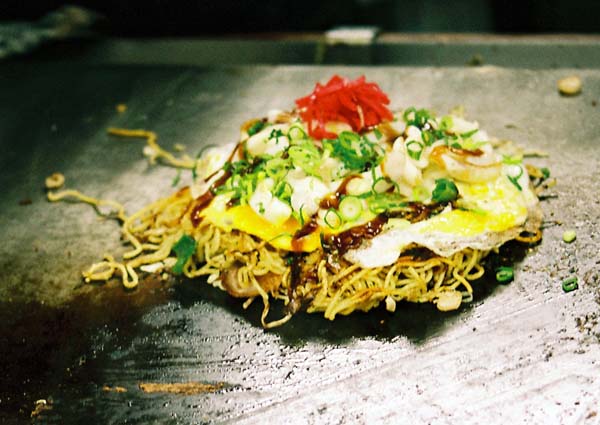
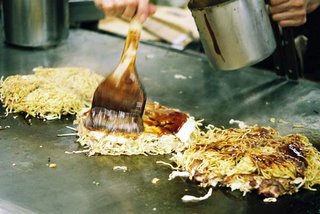 pancake style sandwich, it’s made on a hotplate that doubles as the bench at which you sit. The smiling women seemed quite used to having their photos taken and I went a bit nuts with my camera as they prepared this elaborate dish in front of us, the hotplate between us and them. The pancake batter serves as the top and bottom, in between lies a veritable feast of cabbage, vegetables and most importantly, according to Hiroshima style, fried noodles of the ramen variety. It’s usual to include large quantities of beef, bacon and seafood in between, but this of course was out for me. The whole thing was topped of with slatherings of Special Okonomiyaki Sauce, mayonnaise, seaweed and spring onions. When ready it was cut into four quarters and slid across the hotplate, where you eat it then and there. Can’t get much fresher really.
Yum!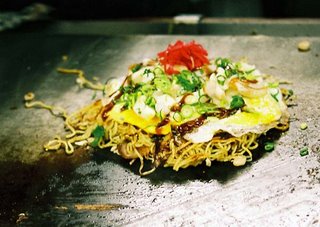 * If you’re more interested in radiation effects, I found this information at a little site put together by Hiroshima International School. Thank you.
It was an icy cold morning. As we drove out to the stadium there was a thick layer of frost on the fallow fields, waiting for the soba sowing. It was much too cold to be running. Manabe Sensei picked me up at 8:30 in the morning; we had to register an hour before the race began at 10:30, and the roads were packed.
The occupants of the cars all around us were fitted out in designer running gear. Manabe San was wearing a brand new pair of runners, bought especially for the occasion. They were crisp and white like the harsh light attacking me through the windows. I wanted to drop them in a muddy puddle for him, but remembered we were in Japan and crisp white sneakers were cool here. My own, though in perfectly good repair, looked somewhat shabby. I’d spent a fair bit of money on them a year ago in lieu of paying fees for a gym I didn’t like. Since then they had been running on beaches, roads, next to the lake at Mum’s place and through the dusty Australian bush. They weren’t a fashion statement despite the expensive logo that could get me into trouble with many of my peers. I didn’t even own a pair of trackpants. A decision I was regretting as I looked out at the frosty soil. I’d looked in the sports stores, but reused to outlay upwards of $60 on clothing I would probably only wear around my house.
At the end of last year Manabe Sensei had come into school proudly bearing an English copy of an application form for the Marugame Half Marathon, and invited me to run with him. It would be the 60th Anniversary and therefore somewhat of an event. The organisers were keen for gaigin to participate and had therefore waived the entry fee for anyone not of Japanese decent. Winter hadn’t kicked in yet and I agreed enthusiastically, not realising it was scheduled for the coldest part of the Japanese calendar. There was a 1km race for kids and then the adults were split into 3km, 5km and 20km races. I’d only been running for a year, since Sebast, my housemate, and I, had been dragging each other up and down Merri Creek, in efforts to run off hangovers when we were capable. I would literally die before I could complete the half marathon. However I’d been running out to the mouth of the river pretty regularly, a distance of about 3km, so decided to up the ante and set myself a challenge. With some trepidation I ticked the 5km box.
I began training that day. We had thirty five minutes to complete the course. I asked one of the maths teachers to help me work out the times, my own skills having fallen into disrepair. I had to run at 8.7km/hr to complete the race in the allocated time. This was a matter of some concern. I knew after the first kilometre I would probably fall back to a tortoise pace. I took my sneakers back home for Christmas and ran everyday in the sweltering heat. Just after returning to Japan, I ran 5km for the first time in my life, at the gym. Actually I ran about three, slowed down to a walk for a couple hundred metres, ran some more, walked some, ran some, walked some etc. But I did it just under the thirty five minute limit. I was going to make it.
Then I was knocked flat on my back by the bout of flu currently doing the rounds. For almost a week I did nothing but sleep and sweat, playing with delirium all night after sleeping all day. I lost two kilos in about three days. A week before the race I was still coughing my lungs up after doing anything more strenuous that a casual walk, and even then sometimes! My cough had turned bronchial and seemed quite happy residing in the moist warm depths of my chest. I was scaring the staff at the gym by falling off the treadmill during heavy fits of phlegm exorcism. But I knew the only way to get healthy was to get fit again quickly and chase and sweat the germs out of my body.
We found the registration desk and went in search of coffee, a feat harder than one would expect in Japan. I had to participate in some dumb parade showing off the international community. We descended the steps and I spotted a union jack next to the southern cross. I went over to join my fellow Australasians to discover we were from the same continent but not country. How completely embarrassing. In front of the Vice Principal of the most prestigious elementary school in the prefecture, I had mistaken the Kiwi flag for the Aussie. I waited for the ground to swallow me up but instead found myself at the front of the procession with the two other A for Australians.
The Marugame Half Marathon is an important race. I don’t understand how running competitions work, but it attracts international athletes. I was told many times that day that the Japanese Olympic Gold Medal Winner for marathon running would be attending. Ironically no-one I talked to was really sure whether she had won at Sydney or Athens, or what her name was. So with V.I.P.s watching, we had to walk around the track waving and smiling at the crowd. If I could only find that hole in the ground. Luckily it was over pretty quickly and then we were all kidnapped and taken below the bleachers to receive our race numbers. That however, took an inordinately long time, and I wondered whether this was some fiendish plan to rid Kagawa of gaigin. When I finally escaped and headed back to where Manabe San had said e would meet me, he had long given up and gone off looking for me. Luckily I met Miyazaki Sensei, another teacher from the school, and he did the tricky mobile phone thing and we all met up.
The race itself was horrible. I was under fit and under prepared. Despite the offer to run together, Manabe San and Miyazaki San both shot off at the beginning leaving me to try and find my own steady pace within a surge of bodies. We ran around the track inside the stadium once and out and up the road. However, before completing the first 400 metres, I knew I didn’t have the energy for this today and it was going to be hell. I trundled along watching as legs upon legs ran past me. I tried not to think about competing and only of finishing. Most depressing was the bandy legged old man of at least 70, I kid you not, whom I couldn’t seem to catch up with.
About a third the way through the race I head encouraging screams of “Kirstie! Ganbaru!” do your best, and the beaming faces of my landlords clutching homemade Australian flags. I grinned back, afraid to put my lungs under anymore pressure, and found an extra spurt of energy for my legs. Hirata Naohisa San had to work that day, but his mother, wife and young son were there with bells on. These guys would have to be the nicest people I know in Japan. They’re just super friendly, always helpful, always interested in my life, past and present, always giving me gifts of some sort and seem genuinely concerned for my welfare.
By now there were runners coming back down the road I was battling up. Clearly there was a turning point somewhere in the distance. I started thinking about slowing down to a walk, but no-one around me seemed to be doing likewise. Everyone was persistently keeping their legs bouncing up and down and there crowds of people watching along the sidelines. I seemed to be attracting more cries than most of Gambaru! Perhaps because I was a gaigin, perhaps because I looked closer than most to falling over backwards. However I felt that if I walked I would be letting all these people down too. I’m in Japan, the land of perfection and perseverance. I couldn’t just give up, even for 100 metres. And so I kept up a vague pretence of running.
As we headed back to the stadium, race clocks on the side of the road read over thirty minutes. I knew I was running slowly, but I didn’t think I was doing that badly. As we headed back the clocks were over forty and all I wanted to do was finish in under 50 minutes. I headed back through the entrance and hoped that the finish line would be soon. There were orange cones dividing up the race track, and as I tried to cross over to where everyone seemed to be collapsing, a fellow runner indicated that we had to run around the track one more time. That last 400 metres was pure hell, and if it wasn’t for my new running buddy by my side i don’t think I would have made it. Back inside the stadium, with thousands of people in the stands watching, there was no way I could walk now.
Finally however, I made it, and immediately keeled over and coughed up a couple of litres of crap from my lungs. Manabe San and Miyazaki San found me and ran off to collect some water for me from the free stand. I went off to deposit the nifty technological attachment to my shoelaces that somehow had registered my time for me. There must have been sensors at the beginning end and halfway points. As the clock was now reading 48 minutes I was severely disappointed in myself and just wanted to get home to a hot bath. As the sweat cooled on my body and the reality of a cold winter’s day seeped into my bones I once again regretted not having bought those expensive trackpants to run in.
When Manabe Sensei had picked me up he had invited me out to lunch with him and his family after the race. I wondered what we were standing around waiting for when the first of the half marathon runners came zooming into the stadium. They were amazing. They had just run twenty kilometres but were still running faster than I could probably sprint in a fifty metre dash, if I really had to catch a bus, say. Their muscles gleamed under shiny sweaty skin and the first runner crossed line in a time of one hour. Wow! That means they ran at 20km/hr for an hour straight. It was then the two teachers at my side told me that the clock hadn’t been showing my time at all, but that of the real race contestants. I felt somewhat better.
We headed off past the results computers and had a card printed out showing our stats. I had run a time of 32 minutes 21 seconds, my best time ever despite being sick. Unfortunately I came 130th/180 female competitors. Already thinking about next year I decided I wanted to get below thirty minutes. Cold and weary, but content, Manabe Sensei and I bade farewell to Miyazaki Sensei and went off to meet his wife and daughter for beer and pizza. In the car we looked forward to respectively well deserved lazy afternoons of warm couches and videos.
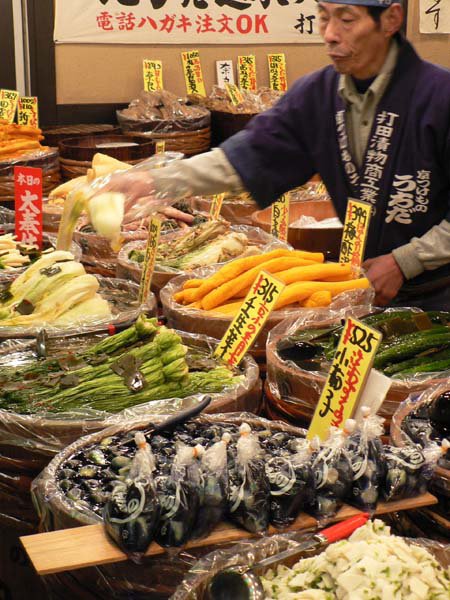
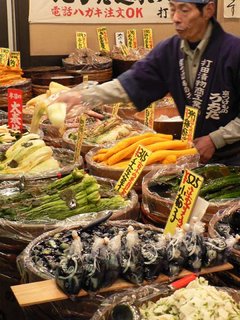 I dropped my pack at the hotel, but still had several hours before I would be allowed a bed to rest upon. So I wandered into the midst of downtown Kyoto and found myself on the main drag, surrounded by classy department stores. Impressive, but not what I had come to see. I struck off down a side street and came across a long undercover market selling every variety of Japanese food available. I was in heaven. Rice crackers, rice vinegar, rice wine, different grades of plain rice, rice pounded into mochi. Unidentifiable pickled vegetables, candies in minute design, barbequed skewered things, bread crumbed deep fried things. Some things packaged in layers upon layers, others opened for the prodding. There’s an essence of foreign food markets that tantalises the senses and emphasizes the differences between cultures more than
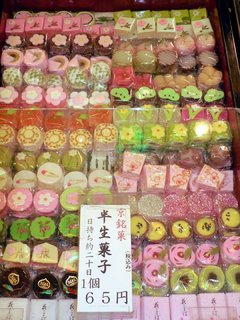 anything else. At such times I have mixed feelings about my vegetarianism. So many intriguing delicacies, so many that strike my stomach with fear and loathing! The camera came out and went click, click, click. A synthesized digital click to make the 35mm fan feel more comfortable. But the click is the same length whether the shutter speed is one sixtieth or one five hundredth. Somewhat disconcerting.
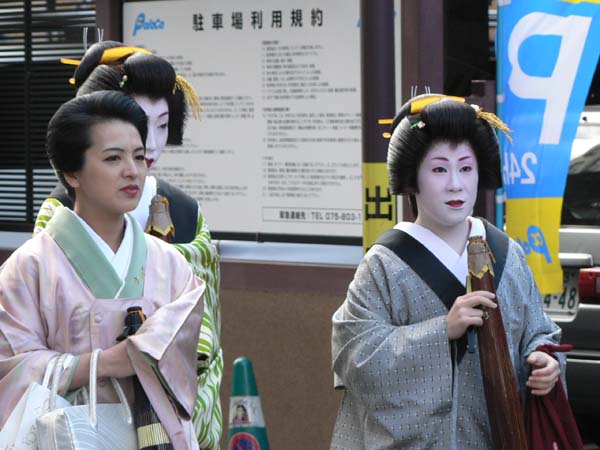
I wound through back alleyways, through funky clothing districts, Gion, the theatre district, where I went chasing after Kabuki dancers in the touristy mission of another photograph. 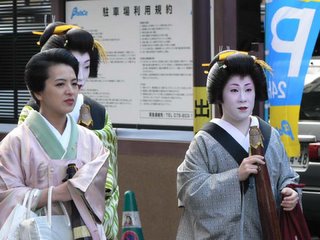 At first I thought they were Geisha, felt myself transported back into a more romantic era, the quintessence of the foreign conception of Japan. Geisha in Gion tripping down narrow alleyways in the impending evening to entertain wealthy, if not noble, men in teahouses scattered in quiet corners. But the surroundings were nothing like I’d imagined in the library of Japanese novels I’d been reading over the past fours years. But I was finally here and it was deliciously different and despite hoards of tourists, cars, modern buildings et al I was here - mind, body and spirit entwined.
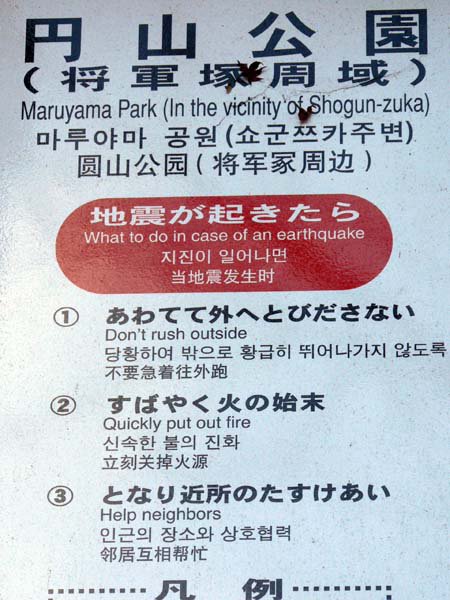
I finally ended up outside Yasaka Shrine and Maruyama Park. Whilst looking for a toilet I found a noteworthy sign:
What to do in case of an earthquake.
Don’t rush outside.
Quickly put out fire.
Help neighbours.
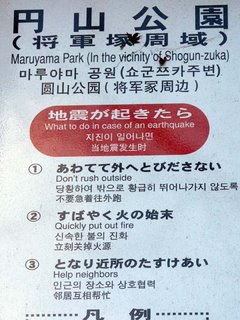
The name Kobe came to mind, a city not so far away, forever connected to the idea of earthquakes in Japan, as Hiroshima and Nagasaki will always call forth more menacing connections. Over the next couple of days I would see these earthquake signs in localities all over Kyoto. I wondered why we didn’t have them on my little backwoods island of Shikoku. Were Japanese earthquakes too short ranged to reach the couple hundred kilometres away? Or does my country bumpkin island not rate as significant. The Marugame Earthquake. It doesn’t have quite the same ring. I hope. Thank goodness there’s only the Inland Sea between us and Kobe and not the Indian Ocean.
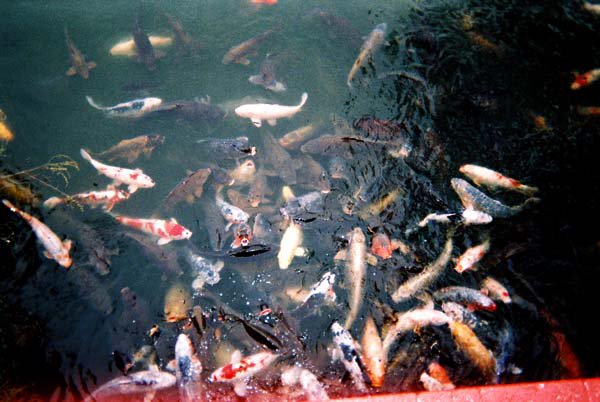
The steps leading up to the shrine were packed, as was the immediate complex. However a short walk towards the park and I found myself in a deserted temple complex and carried into my own personal nook of serenity. I breathed deep and long and moved on. I found a carp pond in the adjoining park and rested my weary legs on a sunny rock, hours of travel finally taking their toll.
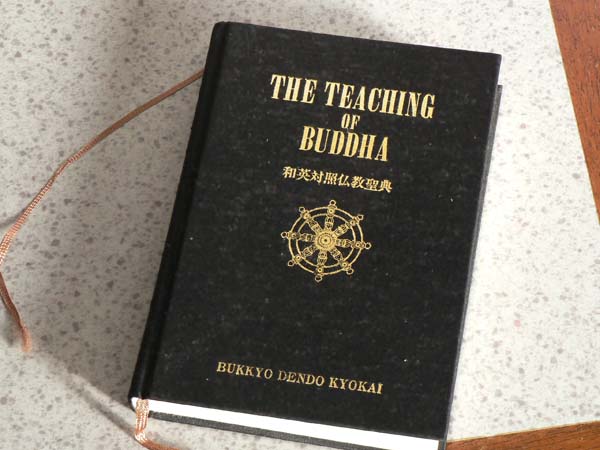
Back at the hotel I was astonished and delighted to find the Book of Buddha in my bedside drawer, printed in both English and Japanese. I donned my yukatta and wriggled beneath a comfortingly heavy quilt. 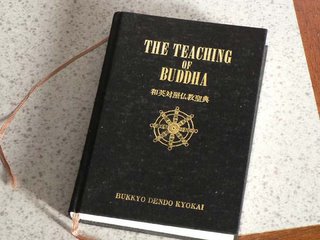
The next morning I awoke refreshed and happy! In Kyoto! A day of sightseeing ahead of me. I love these days where you wake up and know, for the whole day, you have only yourself to answer to. Yesterday I had my aimless wander; the joy of coming across unexpected adventures, today it was time for a more structured approach. A guidebook and several maps were in order, as was coffee and breakfast. In a cafe next to Kyoto Station, drinking bad coffee and munching on pancakes that had barely sniffed the advertised maple syrup, I decided two allocated destinations were necessary: a temple and a garden. Trying for anything more on a cold blustery day was foolishly begging for sore feet and over kill. Kyoto should be like dessert, where the exquisite aftertaste of a morsel is far preferable to feeling weary and bloated.
Kinkaku (Golden Pavilion) is the most famous temple in Kyoto. The day before I had seen hoards of tourists piling on buses bound there. Kinkaku was out. Leafing through assorted literature I found a temple that had a hall filled with 1001 female warriors, Sanjusangen Do. Destination number 1. Having seen enough sculpted trees to last a lifetime, a rock garden was my second priority, and thus destination number 2 would be Ryoanji Temple. As the temples were at either end of the city, I would also get to spend my day hopping on and off buses, hopefully getting lost in the meantime, a favourite pastime in strange cities.
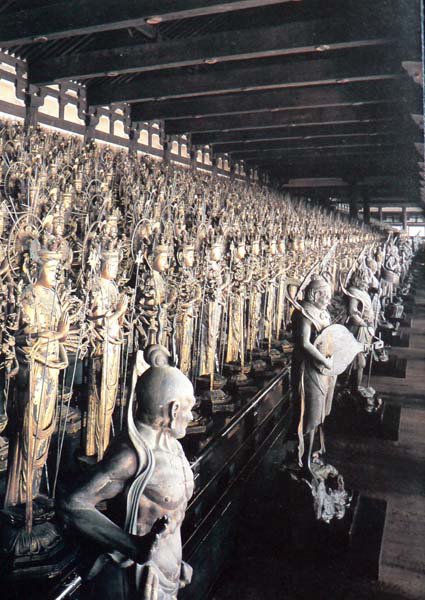
Sanjusangen do was a long wooden hall. The name is derived from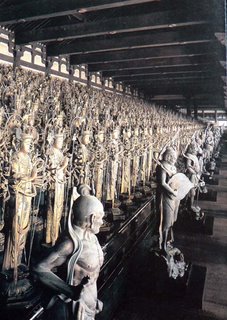 the architectural style and the thirty three spaces between the columns that support the building. There are 1001 statues of Kannon, the Buddhist goddess of mercy, each carved from cypress and coated with lacquer. In front of this army of goddesses are twenty eight other Hindu and Buddhist deities and in the middle is a huge Buddha. The original temple was burned down in 1249, but a faithful copy was reconstructed a short time after and has been standing ever since. No photos were allowed, which increased the atmosphere of reverence the temple had. A lone monk sat chanting in front of the central Buddha, and the air was filled with the smell of cedar wood and the continually burning candles and incense. Despite the unending procession of visitors the temple held a heavy aura of calm. As I regretfully left the building I felt as if time had slowed to half speed.
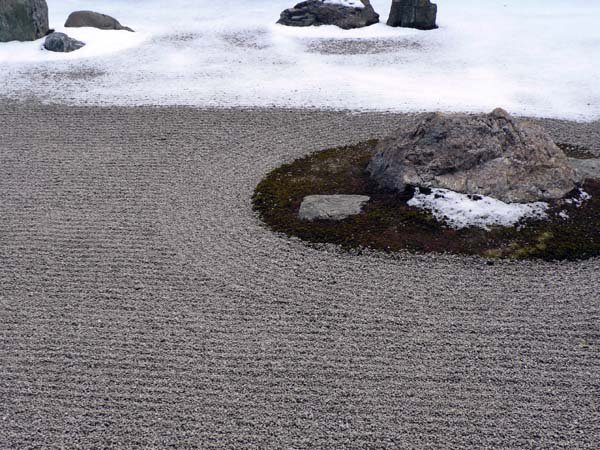
I left Sanjusangen do and crossed the city on a 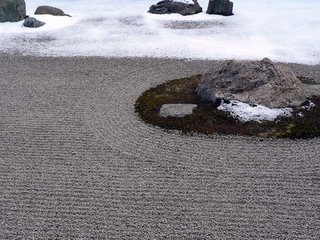 maze of buses. Luckily the bus drivers were pretty helpful and they also had guides at the main tourist interchange points. Walking up the drive towards Roanji do, the bushes sheltered patches of snow from the sunlight struggling valiantly down from above. The rock garden at Roanji do is probably the most famous Zen rock garden of its type. It comprises 15 rocks surrounded by a sea of gravel. I was looking forward to serenely contemplating this panorama for a long time and finding some zen of my own. Unfortunately they were currently renovating the garden wall, which left this
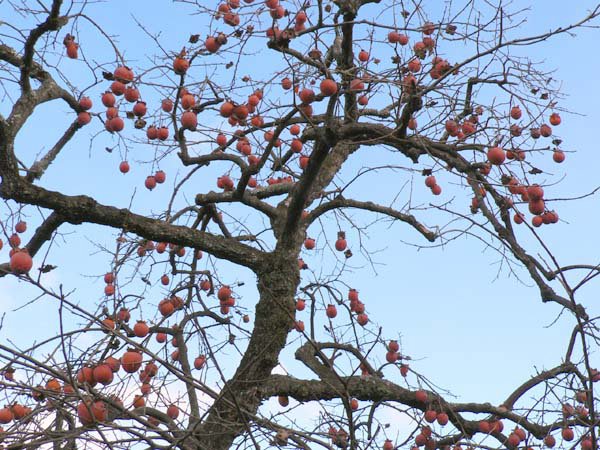
 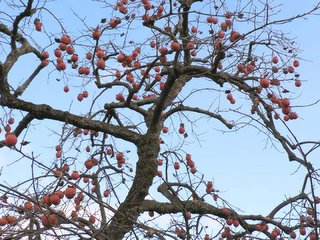 classic scene with a backdrop of tarps and scaffolding which somewhat killed the effect. The bustling, chattering crowd wedged onto a viewing platform at one side of the garden made any form of meditation impossible. I took a couple of interesting shots of the effect the line partially melted snow made across the gravel and headed off to explore the rest of the gardens. I found the beautiful Kyoyochi Pond, partially frozen over with mountainous rocks artfully protruding above the surface. Overhead, a late persimmon tree was showing off the last of its fruit.
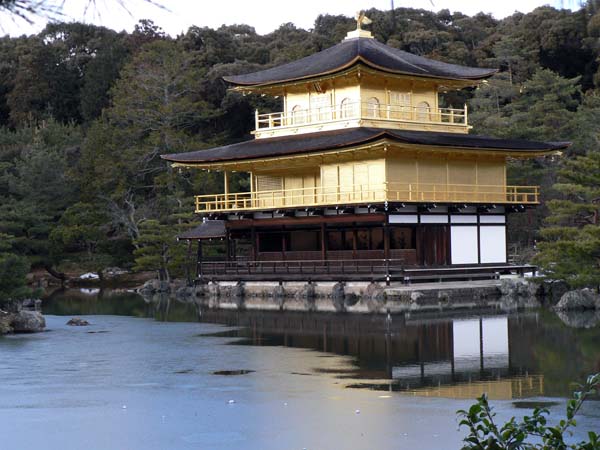
It was still only early afternoon when I wandered out o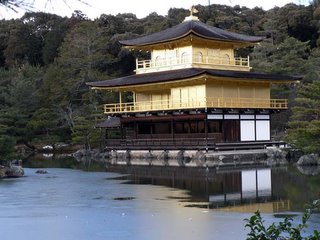 f Roanji do, and as I was in the immediate area I hopped on a bus up the road to Rokuon-ji do which houses the famed Kinkaku, or Golden Temple, so named because its walls are literally coated with a thick coat of gold. It has recently been restored and given a golden coat thicker than the original. On this crisp blue winter’s day the temple gleamed strikingly from its perch on the edge of the lake. The crowds jostling for position in the best vantage points couldn’t take away from the magnificence of this edifice and I was heartily glad I had come. I bought a postcard for my mum in the giftshop and found another score for myself; an English language cookbook on Japanese temple cooking, all of which, in true buddhist tradition, happens to be vegetarian. Tired and happy I scrambled onto a bus and spent the trip back to my hotel gazing over mouth watering dishes. My favourite so far is the tofu fried with almond.
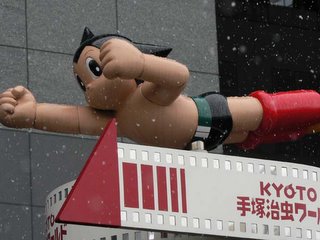 Confused? So is my body!
After experiencing Sydney’s second hottest ever day I flew back into the midst of one of Japan’s coldest winters, and headed to Kyoto, renowned for its cold winters. Transport truly lives up to Japan’s reputation of being exorbitantly expensive. To cross the bridge and get off Shikoku, the island I live on, costs about AUD$60 one-way, whether you car or train it. Thus you can count the number of times I’ve done it without opening your mouth. A weekend clubbing in Osaka could easily eat up a month’s expenses!
But here I was at 7:30 in the morning in the heart of Kansai, the region that covers Kyoto, Osaka and Nara. I didn’t have to be back at work for three days. Santa brought me a pretty decent digital camera for Xmas and temples covered in snow was just too good an opportunity to pass up. So I unzipped my duffel bag and my pack and transferred everything I wouldn’t need for the next three days into one and couriered it off to my bosses house. Yup, In Japan they have this nifty service at the airport where they send your bags on separately for relatively little cash. I think its cause there isn’t enough room on the regular trains for people to struggle on with suitcases and the like.
Almost broke after buying a pack full of books and various other necessities, I declined the shinkansen (bullet train) and caught a common old garden coach to Kyoto. Travelling at 300km/hr will have to wait! I’ve started referring to Japan as ‘home’ and it felt really good to be back as we hooned alongside the Seto Ohashi. As we passed the Kyoto City sign it started to snow and I started to jump up and down in my chair from excitement. I’d been dreaming of snow in Kyoto since I figured out a couple of months back I would have some time to spend there.
Kyoto, the historical and current day seat of Japanese culture. I pushed aside concerns it would be too touristy and a great anti-climax, and focussed on the excitement and the fact I was going in one of the quietest periods of the year, just after one of the major holidays when everyone should be back home.
I jumped off the bus outside the massive Kyoto Station, a ten-floored step like edifice containing a huge departo, and set out looking for the information bureau. There had too be one close in Japan’s most touristy and second most famous city. After travelling straight for 24hrs, with a nasty layover in HCM airport, showers was my first priority and sleep the second.
A hotel was in order. The first thing I noticed was how many gaigin there were around. And as gaigin do, they were all trying incredibly hard to ignore each other. It struck me there are three types of gaigin in Kyoto, however the third type are true tourists and thus do not really belong to the gaigin category. The first type is the Kyoto resident gaigin who are the most disdainful of all tourists and try hard not to be associated in anyway with their western counterparts of whatever colour or creed. Then there’s my category, the tourist gaigin, Japanese residents for taxation purposes but still tourists in Kyoto. I’ve got my backpack strapped over my polar fleece and my new camera slung around my neck. I could almost have stepped out of a Kathmandu catalogue. I look like such a backpacker! But I so desperately want to be differentiated from the other camera waving tourists and hang a sign around my neck say “I live here”. Ah, what’s the point! I follow the gaigin trail to the tourist bureau and queue up neatly to reserve a hotel. Unfortunately check-in time is 2 o’ clock across Kyoto and its only 9:30. Luckily I can drop my bag off at the hotel, but sleep’s a no no for another 4 hours. There’s a public bath across the street though, so a wash and clean clothes are in the near future.
The sento, (Lonely Planet informs me true onsen originate from natural springs, but I can clearly see the running tap in this one) is one of the smallest I’ve ever seen, on a par with the Japanese Baths in Collingwood, not as nice, and nearly as expensive. I guess I am smack bang in the middle of Kyoto, and the proprietors figure they can get away with the cost, being right next to the station. However, the woman who apparently run the place is lovely, and starts to give me the low down on onsen etiquette, clearly mistaking me for an ignorant tourist until I interrupt her with a genki “wakkatta” (understood) and she correctly refiles me in the second category! Just to make clear, interruption is the height of politeness in Japanese society, as long as you do it in the affirmative. It signals to the speaker that you are listening and they have your attention.
For those armchair tourists out there, here’s how the sento/onsen ritual goes. After greetings and small talk about the weather have been exchanged (it’s even more important here than in Britain) shoes are taken off and stashed in a locker. There’s a well next to the door, which is still technically outside even though you wandered in out of the snow three floors up. You step out of your shoes here onto the inside floor and pick up said shoes. Then you empty the entire contents of your pack onto the floor in the search for a clean pair of underwear, as well as T-shirt socks etc and the all important brand new thermal you’ve been dreaming of since you lost your last one at the beginning of winter. All around you are people relaxing, talking, watching TV, smoking, waiting for loved ones and acquaintances. The sento experience is one of buck nakedness. Since the westerners demanded trading rights or war in the Meiji period, bathing has been gender segregated cause the whiteys freaked out about people bathing together. The Japanese women at least, I can’t speak for the men, have taken this enforced modesty well to heart and now wander around with a rightly named “modesty towel” draped over their private bits.
But I’m getting ahead of myself. So, clothes collected I’m handed a modesty towel, about the size of a small hand towel, and rent another big one to dry myself with. I head into the women’s side, a long thin room, lockers over at one side and what my mother would call a vanity unit, next to the door, a row of sinks with accompanying hairdryers, brushes and basic skincare products. I strip, dump my clothes and take my smelly body into the bath room or wet room. I’m confronted with a circular bath in the middle or the room and about 5 or six wash stations on two walls. Climbing into the communal bath is simply not done, but my mischievous side wants to do it just to see what would happen! However not today, tired in a strange city. I wash and scrub and wash and scrub and collapse in the sauna where an inordinately skinny woman is performing a strange rubbing ritual, jumping out, dowsing herself with water and then doing it all over again at two minute intervals. At my gym onsen, the woman perform relay marathon stays of ten minutes interspersed with cold dowsings and ten more minutes, for perhaps whole afternoons. I think they believe it will help them lose weight, or maybe it’s a general circulation thing, but I’ve never seen anyone pummel themselves with a bobbly massage like tool with such fervour whilst in a sauna. I’ve never seen this particular bobbly like massage tool before either.
After I’ve made myself vaguely presentable, dressed and run a hair dryer over my hair before it turns to icicles outside I spot the massage chair. Ahaa, the massage chair, the heaven sent gift for weary travellers. Sit down, lie back relax, drop a buck in the slot and have this strange monster grind rollers up and down your body from your head to your calves for ten minutes. There’s something bizarre about having a machine circularly massage your back, just miss a spot so you try to move into the right position, and then massage your head. But so good, I think, dropping another 100yen coin into its waiting mouth.
A few weeks ago, in the torment of a nasty cold, I drove up the coast in search of fresh sea air to blow the siege of snot from between my ears. It was a beautiful autumn day, colours spread across the mountains that Japan is famous for, lit up with delicate rays of sunshine to their best advantage.
However I diverge from the true point of my story, to get sharply to the point; on the way back I saw mastheads in the distance, a multitude of masts and stays rolling with the faint swell. You cannot imagine my excitement. Before coming here one of my primary goals was to learn to sail in Japanese, a goal that has so far proved elusive, with only the temptation of empty leads to raise my blood pressure.
I drove in the general direction and came across a swanky building with maybe 50 or so vessels stationed on the hardstand in her lee, with another 20 or 30 or so tethered to the floating docks. A real yacht club, though somewhat deserted.
I ventured inside in search of someone, anyone, who might know how to plant me on a boat. I followed a sign that said information, helpfully in English, up the stairs to an empty vestibule. Looking around I spotted a lone woman working in an office and I proceeded to loiter with intent, finding the courage to approach her vanish. Presently she came out, looked at me questioningly and may have said something for all I can remember.
I stammeringly introduced myself, said I was from Australia, sailed in Melbourne, and was currently living here. Though I may be giving myself too much credit for how much information I actually imparted successfully. However, having made it through the necessary formalities, the next bit was the most important. That week I had been studying the –tai verb conjugation. There being no verb for ‘to want to do’ that I have yet discovered, my understanding is that one conjugates the verb to the –tai form and it infers a want to do that verb.
“Watashi wa sayringu o shitai.” I want to do sailing, I ventured. It worked. She understood. Then came the tricky bit. I got a full-length reply about something or other that was met by a blank face on my part. “Racingu o arimasuka.” Do you have racing, I tried next, and congratulated myself heartily for understanding something about how it being wintertime they weren’t racing now but would be again in spring. I offered my stock standard response that I was very sorry but only spoke a little Japanese but am studying very hard, or something like that, unfairly leaving it to her to make the next conversational play. At which point she did something very Japanese: excused herself and ran off to find somebody else who might be able to help!
She came back and took my phone number. I thought that would be the last of it and vowed to come back in the spring when there might be some racing going on. However, a couple of days later, I received a phone call from a man introducing himself as Minami San. We had an interesting conversation until I made my usual apology for my bad Japanese, at which point he confessed he could speak a little English, which made things so much easier. I was being invited to go sailing with him and some friends, two weeks hence, to an island to spend the night and then return the next day. More details than this I was unable to attain, however I effusively accepted and spent the next couple of days in a funk as to how I was going to get out of work.
Chucking a sickie would be the most obvious option, however, currently sick and having taken a couple of mornings off work, it would be less than plausible. Knowing the nature of my boss, being caught in a lie would be inexcusable. There was nothing for it but to pick my timing and rely on her generosity, hoping she understood how badly I needed to go sailing. I gambled well. Nettie helped me ring Minami San back, ascertained the time we would be leaving and what I would need, and told him I would be there. I would have time to teach my Saturday morning classes and could go to the boat to meet Minami San from there. She would deal with my afternoon classes.
Yippee! I was finally going sailing.
There are yachties and there are people who own boats. Until last weekend I never realised how great that gulf can be. I’ve been extremely lucky to have known some exceptional and experienced sailors. I’ve also met some interesting characters whose acquaintance has provided some challenges.
Put two yachties together and they will talk about nothing but sailing, boats, tactics, efficiency, engine repairs, sail repairs, hull repairs, equipment, destinations, the weather, marina costs and conditions. It constantly amazes me the variety of conversations possible connected with sailing. The only exception to this rule I’ve ever witnessed was during the Rugby World Cup. We were in Malaysia, a couple hundred sailors and ninety percent of the fleet was English or Australian. Naturally some strong rivalries came to the fore and sailing was forgotten for a couple of hours. Even I got into some heated barracking!I never pretend to know more than the first thing about sailing. However I know how to get a boat from point A to point B, when to keep my mouth shut and when it’s okay to ask questions. I’m also often the lightest and nimblest person on a yacht. This makes me useful. Weight distribution is important, especially when racing. I get sent forward in rough seas to unhitch the snag, up the mast, preferably not in rough seas, and pushed off the boat to clamber or leap onto a shaky landing pier to secure lines. I like this. It means that I get sent forward before Dave, the experienced foredecky, because he’s 40kgs heavier than me. A boat is the only place where it’s not offensive to get asked your weight.
I arrived at the marina shortly before the appointed time and did some more loitering with intent. Standing in front of the docks I hoped someone would spot the obvious gaigin with blonde hair and come racing over to introduce themselves. All I did was attract a few suspicious glances. Just after twelve I headed back up to the “information”, hoping someone would know who Minami San was. It turned out they did; he worked there, though wasn’t in today, and didn’t seem to be expected, but I didn’t know how to ask if he was coming though not working. I started to panic. However someone appeared who knew something of the affair and I was taken to meet a friend of Minami San who was to take me sailing.
All along, from first being invited, I was never sure how many people were going on this excursion. It sounded like a few, but this was all supposition. I was led down the dock to one of the more expensive yachts in the harbour. A beautiful cruising vessel, just over 40” long, built for a retired couple to sail around the world in, with minimum hardship. I was introduced to Mura San and the owner, who asked me to call him Shin San, though all his friends I later met, called him Naka San. One of the many puzzles I never worked out.
To board someone else’s boat, without being asked, is the height of rudeness. So I stood on the dock waiting for an invitation, whilst they looked at me like I was an idiot for not climbing aboard.My bag was heaved on board, which they remarked was very heavy. I had my wet weather gear inside and two complete changes of clothes. I’m used to sailing on Port Phillip Bay which gets rough, and in the wrong mood the ocean dumps buckets of Antarctic seawater down your neck every minute or so. I was expecting to be quizzed later about sailing in Australia so I didn’t offer an explanation at this point. My dictionary was in my bag, which I’d just been separated from.
We filled up with fuel and motored out the harbour. I was shown over the boat, given my own cabin and offered a beer. I was introduced to peanuts and asked if I’d eaten them before! I pulled out the fruit and Pringles I’d brought along as a contribution, but left the bottle stashed in my bag for a time more appropriate. Going sailing with people for the first time is always awkward, however things were looking up. However it seemed odd that beer was a greater priority than getting the sails hoisted. I’d already donned my sorely neglected sailing gloves, checked over the rigging, found the main halyard and thought it odd that though the cabin and woodwork were immaculate, the sails and sheets at first glance seemed old and tatty.
Over beer I was shown the chart, happily in English and Japanese. Where we had left, were going, our current position and where I lived were all pointed out to me with many accompanying “sooo desu ne”s on my part, agreeable interruption being a common facet of Japanese conversation. It would take 2.5 to 3 hours to reach our destination. That chart was to come out every five minutes or so for the rest of the voyage, GPS position taken and points precisely plotted. I looked longingly at the sails and the end of the peninsular we were sailing alongside that was sheltering us somewhat from the wind. We must be waiting to get out of the wind shadow before setting sail, I thought reflectively.
I was asked if I had had lunch. I hate trick questions like that. I had snacked beforehand, so I would be prepared to eat or not eat. Eventually it was ascertained that they had not eaten either and I was offered ramen, cup noodles. I happily accepted and my offers to help were rejected. So I sat on deck sipping the last of my beer and looking at the bare mast. I rejected the proffered fork and spoon, asked for o-hashi and was later complimented on my use of chopsticks. For some reason that always bugs me. Maybe because it happens every time I eat in public. I want to start complimenting Asians on their use of knives and forks. Its like being asked if I eat bread or rice. Japanese truly think Westerners live on sandwiches and hamburgers.
Small talk was had. Both men were over 60 and retired. Mura San spoke pretty good English and had little patience for letting me practice my Japanese. I found out that Shin San, the owner of this rather expensive boat, was previously, as Mura San phrased it, the head policeman in Kagawa Ken. A ken or prefecture in Japan is similar to a state in Australia or the US. A quiet demure man in his pristine Helly Hansen sailing clothes, he didn’t look capable of kicking in the necessary heads to get to a position like that.
I finally asked when we would hoist the sails. I was told the wind was blowing in the wrong direction; as we were sailing directly into the wind we would be motoring the whole way. My stomach contracted several sizes as the imaginary fist buried itself within. I felt like vomiting bitterness and didn’t know whether to laugh in derision or cry. That explained the ropes that were frayed where they had been continually flogging against the safety rails. That explained so much I didn’t want to know.A few weeks earlier I had been overjoyed and puzzled at seeing two yachts out on the sea near my house. Neither yacht had its sails raised. I live at the mouth of Dokigawa, Doki River. It flows into the Seto Ohashi Inland Sea that separates Shikoku, Kyushu and Honshu, three of the four main islands of Japan. Guidebooks describe the Seto Ohashi as one of the most beautiful pieces of water in the world. Personally I’d rank it below the Andaman Sea and Halong Bay, but it leaves Sydney Harbour for dead. Right at the mouth of Dokigawa there is a small island. I go running out there along the water and dream of taking a small dhingy around the island. The Seto Ohashi is one big archipelago of such islands of differing sizes. Winds blow across her at about 5-10 knots with gusts up to 15. Once when it was really windy I saw white caps out there. Otherwise it’s as flat as my local swimming pool. The sort of conditions Savage would kick arse in. Savage was the boat I crewed on in Melbourne. Too light for heavy seas she was at her happiest with 7 knots of wind and a flat bay. We would cream the rest of the fleet on afternoons like those.
One cannot sail closer than 45 degrees into the wind. So one zig zags along turning 90 degrees across the wind slowly going in a round about way towards the wind. Yacht races are designed to make one sail into the wind to test skill. One doesn’t go sailing in order to arrive at a destination any more than long distance runners are concerned with the final locale. A destination is purely an excuse to do what you love.
Sailing conditions on the Seto Ohashi are close to perfect. So many days I have ridden over the bridge, looked out on this sea and yearned to be on a boat, feeling the play of the wind in the sails. Here I was, on that boat, but with no sails to play with. Because the wind was blowing in the wrong direction. I wanted to jump ship that very minute and swim to shore. We were still alongside the peninsular. It was less than a kilometre away. The sea was flat. I could make it!
We motored into a little fishing harbour on the isle of Shiraishi. A gorgeous place, Shin San and I took a walk around. There were few cars; tiny alleyways flanked by traditional houses and mountains on the west side stretching up to shelter the hamlet from the worst of the weather. Mandarins covered trees in front courtyards and we bought a bag for 100 yen. A tiny idyll. On the way back to the boat Shin San wondered if the other boat had arrived yet. Ahh another boat. This was the first of it. We were all to go out to dinner together at a minshuku on the beach at the next cove.
I had been dreading this moment. On the car all the way up to the boat I had been considering my vegetarian status. I have a policy when overseas of compromising my vegetarianism if it would be rude or culturally insensitive not to. This was one of those times. I still wanted to impress these men. They might have friends who liked sailing even if they were more into the image than the practice. We made our way to the restaurant and a lot of alcohol was brought out. They were sailors in that respect anyway! The meal was all fish. Weird bits of seafood and sashimi (raw fish) were brought out. I downed my first beer very quickly hoping to find some courage to eat in the bottom of the glass.
We ate and we drank and we laughed and they took photos of the gaigin to put in their club newsletter. The non-sailing almost didn’t matter. And then we went back to the boat and I crashed out in my private cabin. Unfortunately I woke some hours later to find my stomach fighting with the seafood I had forced inside it. I had forgotten how much effort it took to cleanse my body of the Mongolian mutton. I was very, very sick. The alcohol didn’t help much either.
The next morning I slept in, my body exhausted from throwing up quietly all night. I politely refused breakfast, wanting to rest my poor overworked stomach. We went for a walk that turned into a hike up the mountains and witnessed beautiful views. I was left pretty much to myself, which was fine by me. I was much happier soaking in the breeze and the sunshine than struggling with language.
On the return journey the wind was blowing in the ‘right’ direction and my paranoid self was wondering if I was being punished for not being able to hold my alcohol as they clearly saw it. Trying to explain otherwise would sound lame and in the light of day I had less need for these men’s approval. I retreated forward, pulled out my iPod and tried to enjoy the ride.
The other yacht raised a main sail and I excitedly glanced back to the cockpit to see if we would do likewise. Shin San merely pulled out his GPS and checked our position, though it was blatantly obvious in which direction we were going. As I wondered why the other yacht hadn’t raised a jib (the second front sail that funnels the wind into a high pressure system that pulls the main sail and the boat forward) they did so and I watched it flap about, badly trimmed, for ten minutes or so until they gave up and yanked it down.
Back in the pens at Neo Cho, the boys said “sayonara”, literally, didn’t help with my bags and I didn’t glance back as I walked to my car. The next day in the supermarket I had to walk through the extensive fish department and I nearly threw up all over again. I think my cravings for seafood have been well and truly cured. As for my cravings for sailing, they will have to wait until xmas when I’m coming home to see my mum and sister, my half share of a laser dhingy and a beautiful lake.
At the beginning of kindergarten and grade one classes, we always ask the kids a bunch of questions: what animal do you like? What food do you like? What sportusu do you like? – hamtaaro, peeza, dodge ball. I’m never sure about the last one. Does it really qualify as a sport? Will we see it in the Beijing Olympics?
But then one cold rainy weekend I’m trying to stomach the daikon soup – a Japanese style turnip – I’ve just made, flicking channels on my old TV, itself constantly flicking between green and colour, and there it is! Okay, Japanese TV is famous for its craziness, though all I ever seem to find are bad soap operas (okay, an obvious oxymoron), baseball, news I don’t understand, baseball and more soap operas.
But SUPER DODGEBALL could save my starved intellect. I’m guessing it’s not big yet as they are still explaining the rules at the beginning of the programme. They never do that with baseball, though in true I’ve never lasted more than 28 secs into a game of baseball. They don’t even have seagulls on the pitch.
Okay, SUPER DODGEBALL; two opposing teams, two balls, 5 starting players on each team. The aim, as far as I could see, is to beat the crap out of an opponent with a ball a touch smaller than a volleyball, which can be held in a large palm. After flinging all your weight behind this ball in the direction of said opponent, if you succeed in a direct hit, they are eliminated. Sayonara. However, if they manage to catch this hurtling piece of leather, they get an extra player brought onto their team. Double however, if you target your unlucky opponent in the head, you get an extra player. When all players are eliminated from one team, the other team wins. Obvious really!
Funniest home videos would pay a fortune for the slo-mo instant replay of this woman getting smacked in the side of the cheek. George Bush should fight wars this way and trade all his weapons stock for shares in CNN. Ratings would skyrocket if you had a bunch of guys out in the desert hurling leather balls at each other. It could be the new chess. Even I’d sign up if I got a free education in exchange for an afternoon of getting my brains pulped out. Cheaper than karate classes and more exciting than uranium coated bullets. And there’s always the chance of a late comeback. Maybe George would even think twice about going to war if there was a chance of a fair fight.
So start up a local club and petition your friendly local Olympic official to include the sport at Beijing. Definitely more entertaining than synchronised swimming.
Spongy stuff, fully packed with softness, in a delicate baking flavour. Best suitable for a sigh of relief at your tea break. Wrapped in the soft rays of the sun . . .
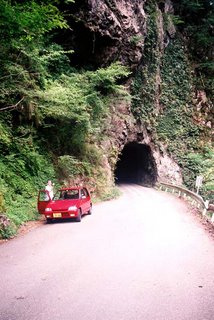 We headed out of Tokushima the next morning, heading southwest, towards the Pacific and some of Japan’s famed surf beaches. We had three nights and four days left before I had to be back at work. Plenty of time to make a circular trip of Eastern Shikoku, and chill out at the same time. Unfortunately, road trips in Japan can be alarmingly deceptive. What with narrow windy roads and a speed limit of 50km/h, which is rarely achieved, travelling a couple of hundred kilometres can take a whole day.
Then there was the problem of where to sleep. I’d gone shopping a couple of days earlier after being paid and bought a tent, eski, camping stove, the works. We had everything necessary for a car camping trip. However we spent much of that day driving, which is what Dom and I had both agreed we didn’t want to do. It was getting late and cooking in daylight was preferable. However I’d picked up some English maps in Tokushima and there were a handful of camping spots clearly marked. We found the first one only because several other campers were already set up. It was, in effect, a gravel carpark, right next to the road. Not quite what I had in mind. I was imagining a soft cushion of grass next to the beach, going to sleep with the waves roaring in the distance, sheltered from the wind by an accommodating bush. This wouldn’t do at all. So we left in search of a back road, somewhere we could hide and enjoy a restful sleep and a leisurely breakfast in the morning. However nothing seemed okay. And we were considering some pretty odd camping spots by this time. Eventually we found another carpark camping spot, but at least this one was next to the water and the rocks and we could wake up and see the ocean. I objected because I was sure my dream was just around the next corner, so we struck a deal that we would drive for another ten minutes, and if nothing eventuated we would come back here. Guess where we ended up setting up!
I’d offered to make dinner and began preparations. However, I had a wee tad accident. I lit my brand new camping stove after screwing the gas bottle on as tight as I was able. However, when I tested it and tried to turn it off, I couldn’t make the flame reduce, let alone go out. The next thing I knew the flames were getting bigger and I threw the whole thing as far as I could away from the campsite. Unfortunately, in my panic I didn’t take very careful aim and I managed to set alight a small shrub on the side of the mountain. By this time I was freaking out and yelling wildly to Dom for help. He said it took him a while to register that it was me making all the kafuffle and came back to find me rather excitedly trying to extricate the stove with a long stick. One of us kicked it away, I don’t quite remember whom, but by this time the thing was burning ferociously and starting to make a scary whistling noise. We did the sensible thing next – and ran like hell.
Not a moment to soon for just as we reached a safe distance away the stove broke the sound barrier; by speed or volume, I’m not too sure, but the mountain visibly shuddered, unless that was me collapsing in relief.
We adjourned for beer and considered what to do about dinner. There was a restaurant across the road, but on inspection it was shut. However, the flipside of nearly setting the mountain on fire was that there was an awful lot of dry wood and we were camping on gravel, so I’d have to be really stupid to make another mistake. At this stage though, my record wasn’t too good. Dinner proceeded without further mishaps, and as all camped dinners are, was pronounced oishi (delicious in Japanese).
The next day we headed up into the mountains. Around lunchtime we found my perfect camping spot. A disused road that headed down to a small bridge that ended abruptly on the other side. A creek tumbled and gurgled along the river pebbles, and I finally got my quiet time in the mountains, sitting Sidharta like for a long time having conversations with the shallow rapids.
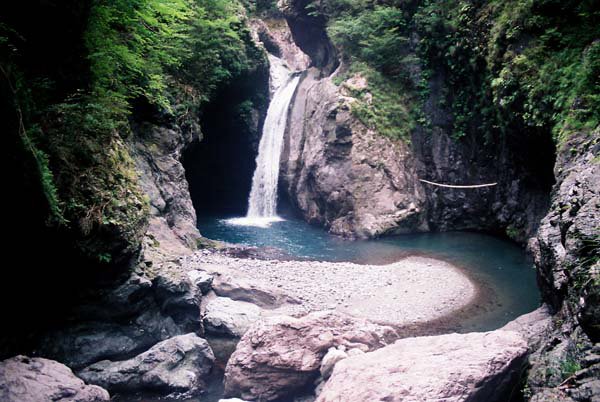
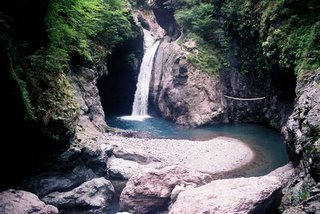 Japan is riddled with long tunnels stretching up to almost two kilometres. The longest one I’ve found was 1852m. On the way back to Kagawa Prefecture we came out of one of these and ran into a viewing platform overlooking a waterfall tumbling into a pristine swimming hole. We clambered down and dipped our feet into the deliciously icy water. The middle of summer I had been too hot for weeks and neither of us needed much encouragement to overcome bashfulness, strip off and plunge into the clear stillness. That was the last highlight of our trip. That night we ended up staying at a big campsite and eating dinner at a Korean restaurant. I had my first authentic bibimbop in a long time.
 The dancing foolsAnd the watching foolsAre foolish the sameSo why not dance?
We headed to the train station and the local gaigin help centre in search of accommodation leads and information about what was actually going on. Accommodation was scarce and festival inflation had taken hold that weekend. However we found a place to stash stuff and take a nap before the evening’s revelling began.
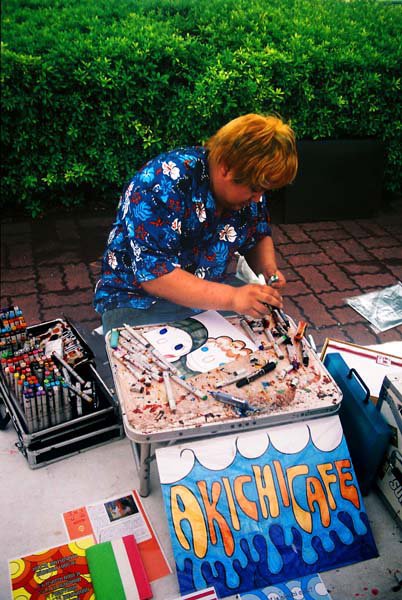
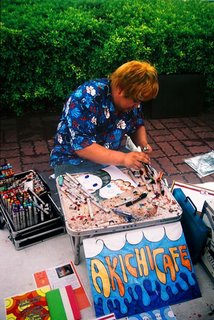
Before heading out to the hotel, Dom and I loitered around the train station and central market place, the epicentre of the buzz in the air. Troupes of dancers were holding half hourly performances in front of a big department store, the sales assistants roping off the audience viewing space in hopes that people might still come and shop in the midst of this hullabaloo. Staking out a spot I noticed a lone artist, set up on the pavement below drawing caricatures of passers by with an army of permanent textas at his side, standing to attention, waiting to be called into action. A few funky Japanese were gathered around, waiting to be drawn, watching his drawing. I grabbed Dom and we headed down to get a closer look and eventually got drawn ourselves. Me with rosy pink cheeks and Dom with a little yellow bird in his nest of hair.
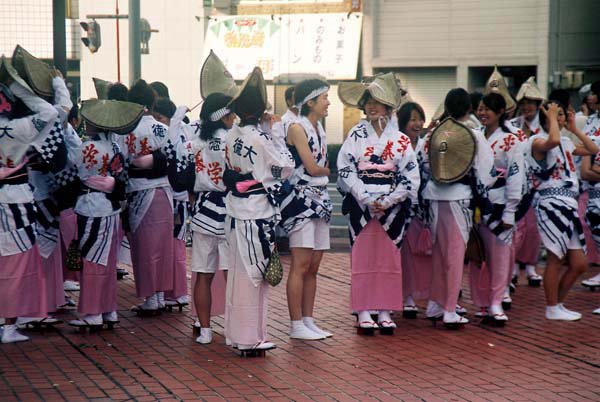
The dancing was of a precise nature, a slow exaggerated walk, knees pulled up high, feet splayed out at 90 degrees to each other. It must have been hell on the thigh muscles doing this for hours at a time. The hands and arms were moving in an almost Balinese style, thumb and forefinger pinched together with all the other fingers elegantly stretched outwards.
It was the clothing that caught my attention. There were a number of outfits on display but one of the most striking, and popular, was a woman’s costume that consisted of a yukatta, a summer style kimono, with Japanese style sandals, geta, that have a rectangular heel at both the front and back, so they resemble little bridges. I’ve been told that these were originally designed for climbing up mountains, enabling one to get a proper foothold. Tabi, white socks imitating mit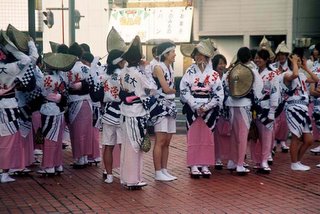 tens, with a separate toe for the big toe are worn inside. The headgear, for it cannot be truly called a hat, looked like a circular rattan mat that had been folded in half and tied under the chin with a ribbon. We watched for a while and then went off in search of the hotel for some kip before returning later, though we almost missed the festivities because my Japanese mistook the ending time for the starting time!
We headed out about 8:30 and wandered into a transformed city. The lanterns lining certain streets heralded the spots most populated with dancers, but all over the city troupes of dances weaved their way through the narrow streets. The dancing was accompanied by shamisen (three stringed guitars), taiko (drums) and fue (flutes). It seemed the musicians had a harder time of it than the dancers but everyone sported their most excitedly demure smiles and the air held an abundance of static energy. The done thing seemed to be to watch a procession of dancers for a while and then wander off in search of the next group, which wasn’t hard as the mingled chants could be heard blocks away.
The energy was infectious, all traces of sleepiness disappeared and I couldn’t keep still, at times jumping up and down on the spot as if I’d had jumping beans for dinner! Everyone wore smiles, everyone was super friendly, as if the Japanese are friendly anyway, and I half ran half jumped around with an idiotic grin spread around my head, attracting more smiles in return which just made the grin wider! Along the streets vendors sold drinks, snacks and tacky souvenirs by the armload. After I couldn’t stand still and watch any longer, we grabbed beers and headed off in search of the next procession. A festival spread over a city is a tricky thing. There’s that feeling of being in the middle of everything, but never quite centred. Narrower alleyways held more intimate displays of music and dance, wider streets threw energy around but provided little space to utilise it among the thronging crowds. Around 10 o’clock the formalites became less so and spectators joined in the dancing revelries. Gaigin were especially popular and we soon had offers left right and upside down to join various groups, eventually weaving from one to another. There was a feeling that it was going to end soon though, a desperate effort to cram in as much fun as possible in the time left pervaded the atmosphere. Vendors started packing up their wares and dancers sat down for the first time in three days and nursed sore feet.
At 11 o’ clock, police vans circled and politely asked everyone to go home. And everyone did. This is the most famous Awa Odori festival in the country, situated in the middle of one of Japans most important holiday weeks, and they shut it down just when it was starting to get interesting. This habit of the Japanese to have a precise starting and ending time for any social event will never stop blowing me away!
Dom and I headed in the direction of the nearest combini and grabbed some more beer to take to a park. We ended up wistfully gazing out onto the docks of the local marina, telling sea stories and planning to buy a boat in which to sail around the world. I believe plans were made in the meantime to rent a yacht out of Phuket next summer and go cruising around the Andamans for a week. If anyone’s interested, we’re looking for a couple of crew, no experienced required, just a strong interest in chilling out!
One of my best friends came over to visit from Korea, where he’s been living for several years. Dom fed and housed me for six weeks whilst I looked for work in Seoul, so I figured it was time to pay back some big favours.
Still living with my boss at that stage, it was a good excuse to leave Kagawa and make true the title for this blog. A trip to the local sports store provided camping equipment, the local information bureaus provided a vague assortment of maps, and after practicing my Japanese on everyone I knew, by asking them their favourite place in Shikoku, we headed east, first stop Tokushima City and the famous Awa Odori Festival.
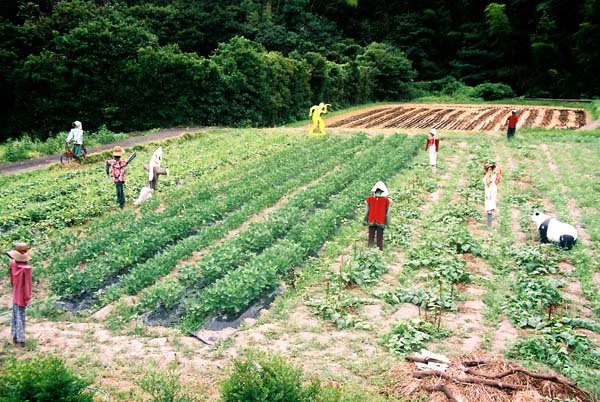
Of course, the first stop is never as intended and a whole host of ‘combini’s provided sumptuous snacking, whilst back roads tempted limitless distraction. Stopping to admire the mountains and bamboo forests, one of the first things noticed was the near decadence of the scarecrows working diligently in the paddies. 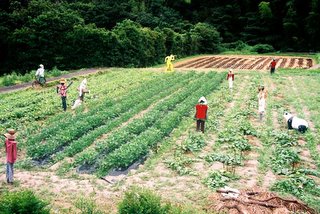 Lifelike figures push wheelbarrows, bend over crops and sometimes ride bicycles; an admirable feat in a rice paddy! Many wear scary Japanese masks and all are outfitted with attention to detail, yet another example of the Japanese preoccupation with perfection. No Worzel Gummidges here.
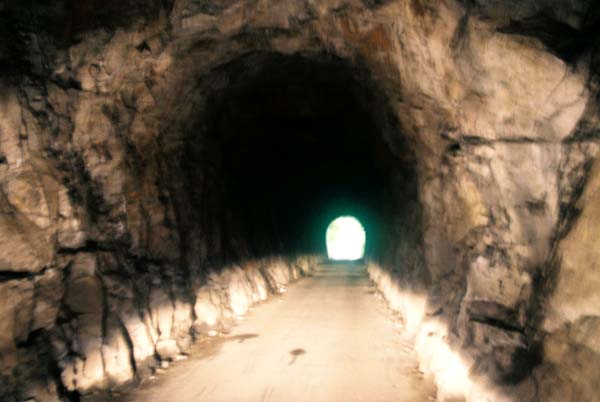
 A windy road up a mountainside ended up at a Spirited Away style tunnel, which went nowhere. An incredibly creepy energy grew in the tunnel and Dom swears he saw something. We both got kinda spooked at about the same time and bailed rather quickly. It’s easy to see where Miyayashi gets his inspiration.
Another winding road led us to an abandoned house, perched on the edge of the mountain, commanding sumptuous views that would probably be snow-capped in winter. It was securely locked with all the belonging still inside, patiently waiting for the owners to return. Any other country and it would have been broken into and trashed long ago. Apparently there are many of these houses in Tokushima Prefecture, their owners long gone to the cities in search of profitable work. I’ve heard said houses may be bought for about 2 million yen if said owners can be tracked down. An interesting option for a mountain retreat. I’d only considered South East Asia before.
Hiking up the hillside, the territorial smell of macaques filled the nostrils. My cautionary fear of monkeys, engendered by vicious brutal Thai varieties, was quickly abandoned as we glimpsed arse after arse disappear into the bushes ahead of our arrival. I’m not sure about camping with packs of reasonably large monkeys around though. Maybe leave a pile of spiky chestnuts, of which they are especially fond, away from the campsite.
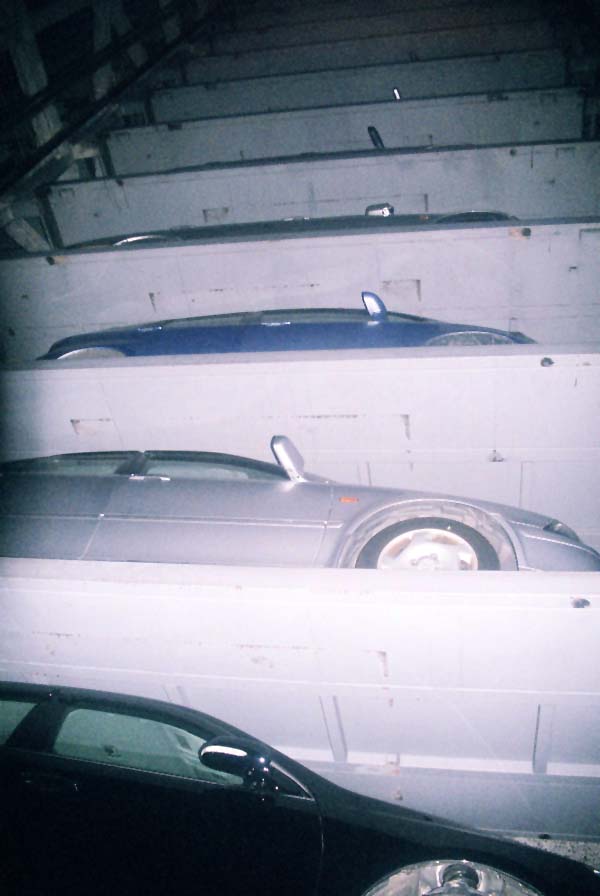
On arriving to Tokushima we encountered the maddest car park. A space where they load your car onto an elevator and stack it above a bunch of other cars. No driving involved. Just some crazy hydraulics. See picture below. 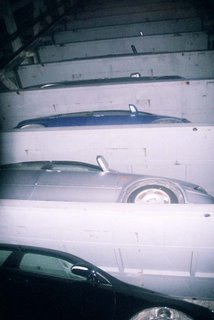 Its like storage compartment for cars. Drive yours onto a lift and they take it away into the hemispheres above, and then file it in its own space. I was completely amazed. One spends so long in a country that you think nothing can truly surprise you any more and then you find a car park. Dom had to drag me away to the festival.
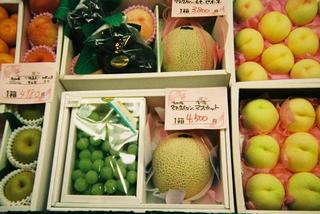 A gift of fruit really does cost the equivalent of $50 aussie.
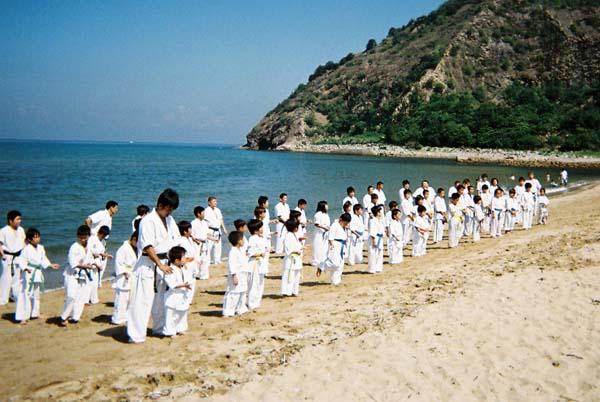
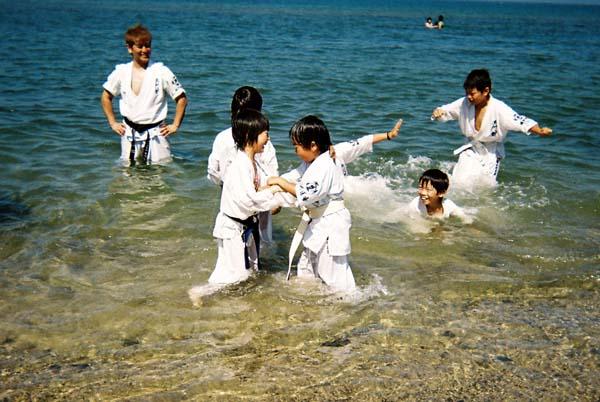
 So much has happened since I last updated these pages. I was waiting for photos to develop before I wrote this one up. We went the beach one hot Sunday. Several kay’s up the coast. My karate dojo and connected dojos. I thought it was a general excuse for a social outing Japanese style, and it was, but it was also an exhibition.
I got a lift with Hiro, who was helping to set up and had to be there at eight. We left shortly after seven; far too early for a Sunday morning, especially when one has been out drinking until 4am the night previous. Being excused from the general set up I promptly found a soon to evaporate patch of shade next to the sea wall, threw myself onto the sand and tried to pass out.
My calm was chased away shortly by a chattering, excited family who set up their picnic table and sunshade right next to where I was trying to block out the piercing light of the sun. I groggily lifted my head and could see nothing but foldout picnic table legs arranged uniformly in rows under similarly congregated shade tents. A huge stretch of beach and apparently thousands of little karate kids and their parents squished into one small area.
A keg of beer was set up, help yourself style, and garbage bins full of ice, alcoholic and soft drinks stood adjacent. A machine making shaved ice was being operated by shifts of keen dads who liberally poured cordial and condensed milk over the cups of ice. Gross as it sounds it tasted really good. A curry was being constructed and rice washed at one end of the camp and the fire built upon which a Japanese style noodle stir fry would dish out hundred of plates of food later. So much for just grabbing a towel, swimmers, sunscreen and bottle of water to take to the beach.
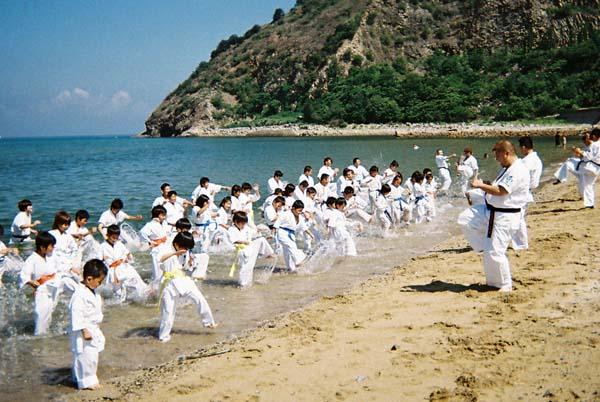
Some of the kids were in their dogis and were playing in the water. This I found somewhat odd. Why would one come to the beach in your karate gear? And go in the water? This conundrum was soon answered when Irikura Sensei, now outfitted in his own dogi, came to get me to inform me it was time to train. I looked at him and laughed. Yeah right. At this stage the celsius was well over the 30 degree mark and steadily climbing. Normal training goes for three hours with regular rehydration breaks. Inside. At night. There is no way any half brained person would train in full summer sun in the middle of the day.

I was asked if I had a dogi, an odd question I thought, as they knew I as yet didn’t. But it seemed like a good excuse to blend into the crowds of parents similarly dressed in shorts and t-shirts. Only recently returned to the dojo after my stint on crutches, a weak ankle seemed like another good excuse to get out of training on sand.
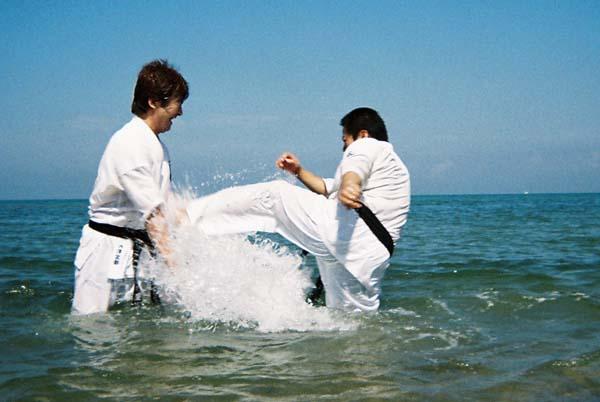
Everyone lined up facing away from the water and proceeded to practice the range of punches, kicks and blocks whose Japanese names still elude me. It looked cool, the row of white clad black belts and wannabes seriously putting on this bizarre display. My nephew’s words of warning about the Japanese being truly weird came back to me, and for the first time I thought maybe he was right. Then everyone moved back several paces, and the older combatants were standing in water, showering everyone with their kicks. Again everyone moved back, completely seriously, up to knees in water it looked really difficult to kick properly. By the time everyone was up to their thighs, hand-to-hand combat was instigated by the Senseis safely instigated on dry land, megaphones in hand.
At this point I appreciated the Japanese talent for silliness. Sternness had been steadily washed away, and now anything went. As combatants switched partners it escalated into a full on water fight with teams being made and war being waged with younger lighter participants hoisted on the backs of their older comrades. I wanted to drop my camera and join the fray, but it was too late now. I hadn’t earnt the right, not today at least.
 The rest of the day was spent eating, drinking, playing in the water and socialising. At a preset time everyone was thanked for coming and politely told it was now time to go home. So everyone did.
I learnt later that this is a traditional event that happens twice a year. Stay posted for the winter episode.
Im a legal alien im an Australian in Japan.No shit, on the top of my alien card it actually says:GOVERNMENT OF JAPAN CERTIFICATE OF ALIEN REGISTRATIONand I thought it was a cute nickname invented by some crazy gaigin.So now Im entitled to open a bank account, move into a house and stir up trouble. Hee hee. Last weekend I was taken house shopping. Well I was shown two. Its difficult for me to get a house because most real estate agents demand key money. A tidy sum which amounts to about 3 months rent, never to be seen again. All the big schools pay it once and then move teachers in and out and write the cash off on tax. My boss isnt that big though, which meant finding a place that is happy with a security deposit. Now I have to come up with four months rent, but its rent in advance. I get it all back except for maybe a months worth, which I can live without. Finding such a place meant calling in favours from Japanese friends, so I didnt want to be a pain in the arse and too picky.The place ive got is pretty cool. Its relatively cheap and really large for one person. Affectionately known as a 2DK it has a big kitchen/ dining room and two adjoining tatami rooms of good size. Tatami are the mats that older houses have and are the traditional way of measuring room size. The rooms also have traditional sliding paper screens. Pretty cool.I have an antique bathroom and a small garden out the back. Its practically a mansion. It doesnt get much light, and is in the industrial part of town, which accounts for the age and ralative cheapness, but Im pretty stoked. The other place I was shown was 1500 yen cheaper and was all windows, light: good, hot in summer, cold in winter: bad. It was one tiny room attached to an equally tiny kitchen and made the grotty communist block apartments in Mongolia feel like the Ghobi.So the upshot is I get to move in about 2 weeks when all the bureacracy has finished and I can afford a fridge. I have lots of room and expect lots of visitors.P.S. My other exciting news is I bought a real bike. I had to order it in especially. A red goes faster Specialized mountain bike that all my Japanese friends are amazed by and my gaigin friends jealous of. Except my boss who cant understand why anyone would spend so much money on a bike. I tried to explain it cost much less than half of my bike back home and then she thought I was really crazy. I can only hope all the cyclists will understand.
 As the title would suggest, I made it out of Kagawa, into the next prefecture. Yesterday I was taken rafting, destination unknown, my favourite sort of adventure. Before arriving, I did a lot of research on the net and in bookstores, on Japan and Shikoku especially. The number one place I wanted to explore was Oboke Gorge, which slices through the mountains in the centre of the island. Pictures I saw were beautiful and it was held up as the last unpolluted river in Japan. Sooo lush.So guess where our rafting destination was. Not hard really. I was sooo excited, prepared to be happy with scenary and a tame boat ride down the river.The weather here has been unrelentingly hot, sans breeze of any rustle. Ive become used to Australian (non) summers again, when you know that the heat will be followed by a few days of cooller weather or rain. Though we complain about the lack of hot days, I must say I rather like the variety, for appreciates everything more.Where to start? I had the most fun Ive had in I cant remember how long. Like we are talking
  years here. After waiting around for an inordinately un-Japanese amount of time we were fitted out with helmets and life jackets, wetsuits for those who wanted them. However the guides said the river was pretty warm and I was quite happy to be refreshingly cold for a day. It hasnt rained in weeks, drought seems to be following me, so the river was low. Tae, Netties 5yr old son was thus allowed to come, making him the youngest person to raft the river. Go Tae, the man!We headed down to the river and ran through basic safety procedures, shown how to float and roll, how to hold the paddle so you dont knock your neighbour for six, and then got to board the boats. If the rapid is not too fast the guide yells "hold on", a big one and we are instructed "get down" doing just that, crouching in the bottom of the boat, holding on. When the river is faster you might have to "go to the right" or "go to the left" to keep the balance in the raft and avoid flipping.
 It was so cool. Descriptions defy me. After negotiating a rapid we all clashed our paddles together and yelled in unison. Water fights with other rafts were encouraged and we jumped off the boat and went swimming between rapids. Admired the view. Floated down the river. Chilled out. Probably annoyed everyone with my constant and unimaginative gushings about how beautiful it all was!!Teru san, our guide, spends summers in Tokushima and summers in NZ. Rafting constantly. This explained his perfect english and radiantly spunky smile. What a life. We tied up to a big rock and climbed up to the top, a feat in mountaineering itself, especially with a recovering ankle. Thank God for frequent swimming and freshly acquired upper body strength. The rock was 5 metres high and we were encouraged to jump off. Teru san demonstrated with a perfectly formed back flip. I stood at the edge and looked down. Five metres seemed an awfully long way down from up there. How deep is it? I asked. He said no one had ever touched the bottom. My next worry was belly flopping or landing wrong. Itae! (ouch). Scary thoughts were careering through my head and I realised I could be the last one up there. Frozen. Dont think, I told my self, 1, 2, 3: I let out a yell and leapt. A split second of "oh shit" looping through my head and then I hit water.The most refreshing water to swim in ever. Pools are nice, the sea is great, but I dont really like the sticky after. Rivers and dams have to be the nicest swimming. Last time I swam it was New Year and freezing cold. I think Ill be going back up to Oboke a lot while it stays hot.
 I couldnt find a waterproof camera before I went, so just got a disposable. The photo guy this morning wasnt positive about how well they would turn out when I explained in scratchy japanese why it was all wet. But its just film and plastic, so Im hopeful. Stay tuned for wicked pix.Some time later, here they are. Check out pix link to ur left for more.Free advertising: http://happyraft.com/ja/
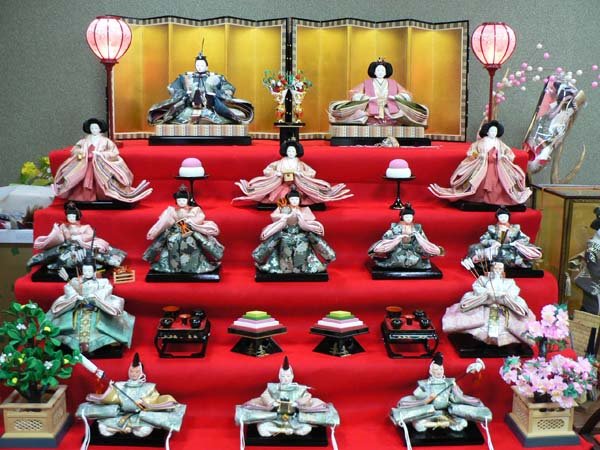 Hina Matsuri, like many things Japanese, was a cleansing custom originally imported from China: a girl’s imperfections are passed into a paper doll which was subsequently floated down the river. In some regions the custom is still practiced. My friend Omae San invited me to view the Hina Doll Festival in the neighbouring town of Utazu. The weekend after the 3rd, families and businesses within the old part of the town had opened up their homes for the general public to view their displays. To be honest, I was much more interested in seeing the inside of Japanese homes than in viewing the doll sets; many newer versions I had seen for sale in stores, and considered a tad gaudy for my taste. We went to the Utazu Town Office to drink some ceremonial sake and collect a map of the walking route. Some 80 or 90 residences were partaking in the festival. It was a beautiful late winter’s Sunday, crisp and blue, pleasant in the sun, a tad nippy in the shade. Our first stop was a very large, old house that has been restored as a museum of some sort. Guides were on hand to explain the history of the dolls and the house, and between their exuberance, Omae San’s patchy English and my delinquent Japanese I think I became more confused than enlightened. I spent a lot of time nodding my head enthusiastically and spouting Ahh sooo desu ne, guessing at meanings that an occasional ray of understanding would splinter into beautiful rainbow textured shards.
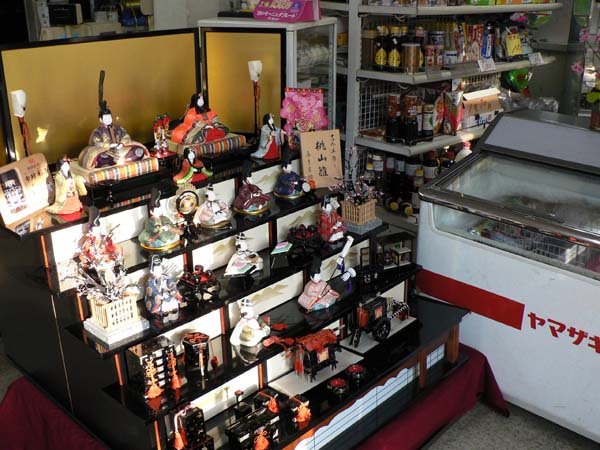
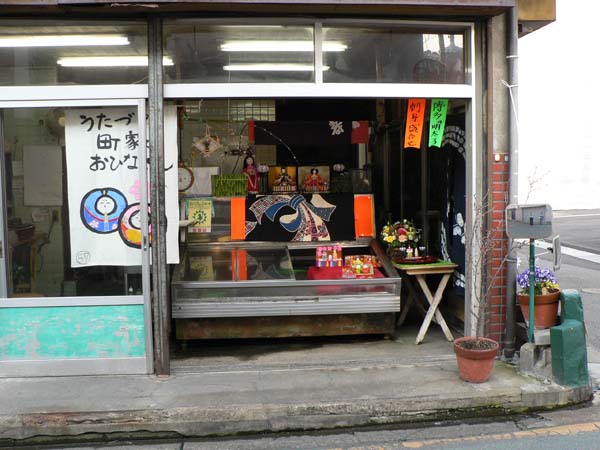 We finally head back outside and followed the meandering groups of people drifting here and there. Some houses had a small display viewable through a window, others had devoted whole rooms to the hospitality of their collections. A few stores had joined in the celebrations; I particularly enjoyed the contrast created by this small grocery store that had forsaken product space for doll space, and a fish shop that had managed to squeeze in a display.